
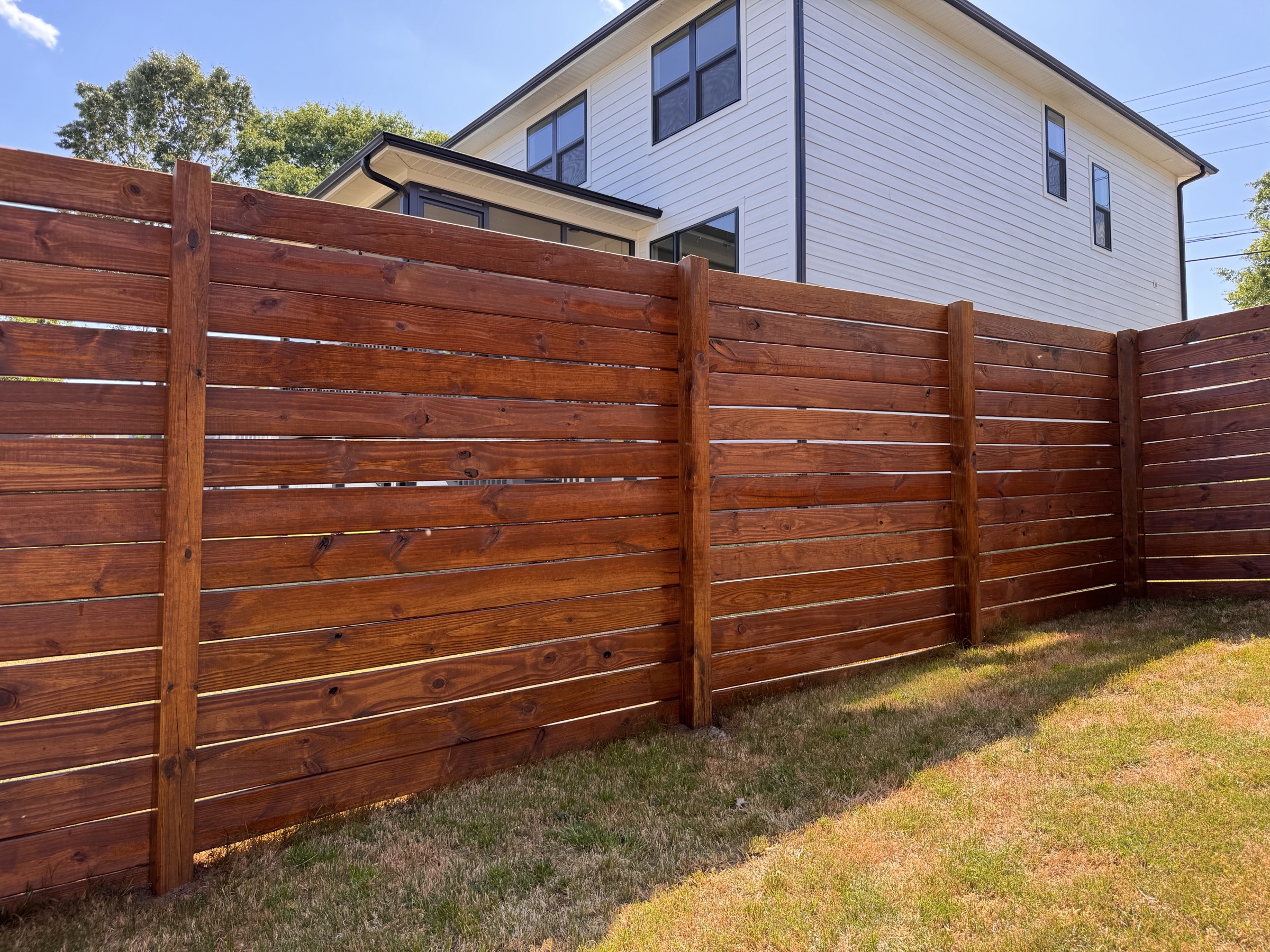
The internet will tell you to wait months, sometimes a full year, before staining a new fence. Sometimes that is right. Often it is how boards cup, twist, and grey while you wait for a rule of thumb that does not know what wood you have or what month it was installed. The honest answer: stain when the wood is ready, not when the calendar says so.
The real test is moisture, not time. Oil-based stain wants wood below 13% moisture, and the only way to know is a meter. We check moisture on every estimate because two fences installed the same week can be months apart in readiness: one from kiln-dried stock stacked in the sun, one from pressure-treated boards that were soaking wet when they went in the ground.
Pressure-treated pine is the usual culprit in long waits. The treatment process leaves boards saturated, and fresh PT stock can take weeks to a couple of months to dry into staining range, depending on the season, the sun exposure, and how the lumber was stored. Kiln-dried-after-treatment (KDAT) lumber skips most of that and can be ready in a week or two. Ask your installer which one is going in your yard.
Cedar plays by friendlier rules. It is usually drier from the yard and can often be stained sooner than wet pine. The catch with cedar and with smooth-planed pine is mill glaze: a polished surface from the mill that beads water and blocks stain. The fix is simple (a wash or light sanding opens it up), but staining over glaze is how you get a finish that washes thin in a year.
Here is what waiting too long costs in our climate. UV starts greying unprotected wood within weeks of a Carolina summer. Dirt, pollen, and mildew move into the open grain. Boards start their wet-dry cycling with no protection, and early checks and cups are set in motion. By the time the "wait a year" crowd stains, they are paying for a wash and sometimes a restoration that a timely coat would have prevented.
Staining too soon costs too, just differently. Trap moisture under an oil-based finish and you get blotch, poor penetration, and peeling. The stain dollar is spent but the protection is not there. This is why "wait months" and "stain immediately" are both bad rules. The wood gets a vote, and the meter is how it votes.
There is a field test you can run yourself: flick water on the boards. If it beads up and sits, the wood is not ready (too wet or mill-glazed). If it soaks in within a few seconds, you are close. The bead test is a decent screen, but a moisture meter is the truth. We bring one to every estimate so nobody is guessing with a four-figure decision.
The practical play: book the estimate when the fence goes in, not when it looks grey. We will meter it, tell you if it is ready or set a check-back date, and put you on the schedule for the first good window after the wood says yes. That turns a guessing game into a plan, and it usually saves the cost of a wash.
New fence in Greenville, Spartanburg, Greer, Duncan, Reidville, or Lyman? Call or text 864-800-8275 or send the form. We will tell you straight whether it is ready, and quote it flat-rate when it is.